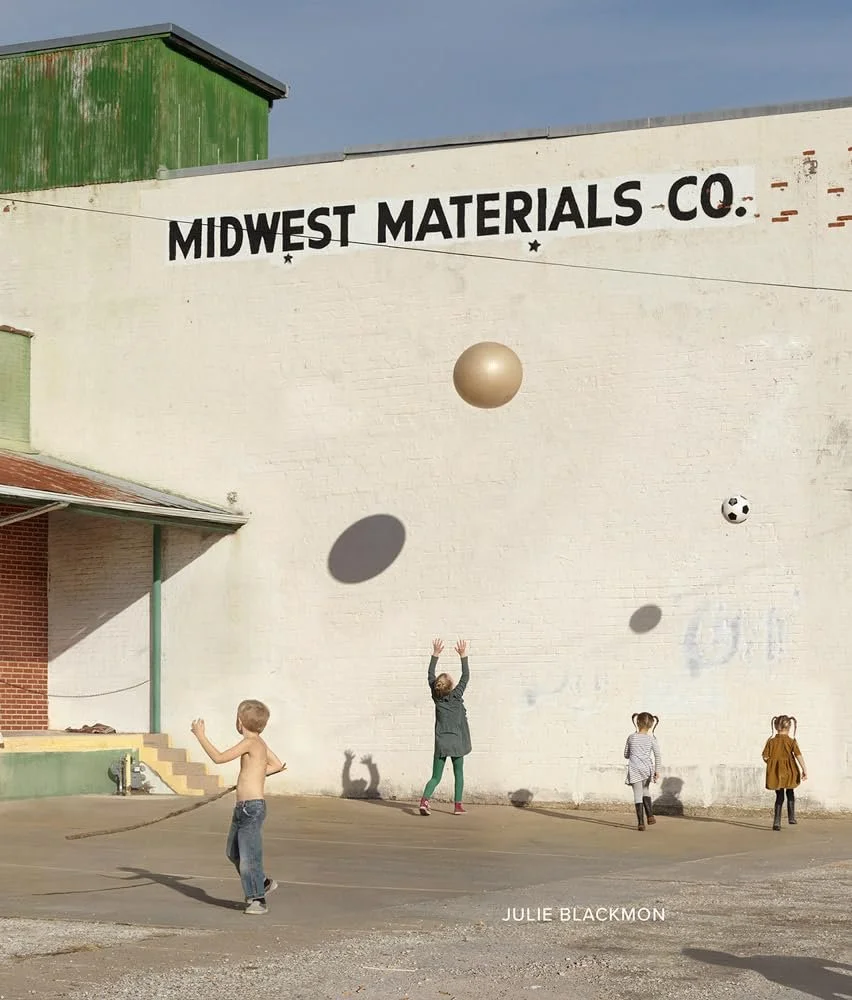
Midwest Materials
Radius Books, 2022
Foreward by Leah Ollman
Stamped across the walls of a commercial building in this volume's titular photograph are the words Midwest Materials, functioning as both external signage and wry internal caption. The words identify what Julie Blackmon works with: place and props; the center of the country, the people and stuff found there. Based in Springfield, Missouri, and part of a large extended family there, Blackmon has used home and the rituals that unfold in backyards, attics, and garages as the raw material for her images for more than fifteen years. Each frame in her ongoing epic is an absorbing, meticulously orchestrated slice of ethnographic theater starring a tribe of scuffed and shirtless nieces, nephews, neighbors, and friends.
If the enjoyment of theater requires us to suspend disbelief, to temporarily accept as true the artifice we're presented, the fullest appreciation of photography asks of us the opposite: to suspend our reflexive belief, to accept (and further, to embrace) as artifice what appears to be truth. Since Blackmon practices photography as theater, she traffics in the seductive illusions and entrancing deceptions of both mediums. Hers is an elaborate and sophisticated act of make- believe. An act of serious mischief. Also, perhaps, an act of frustrated faith, an act of longing.
Her compressed, constructed universe opens out toward us, a stage set with resonant details and choice clues. What Blackmon leaves out of her pictures is just as revealing. We never see these kids doing homework or sulking through their chores. All the time in these scenes is discretionary time, filled with languorous play and innocent indiscretions. Adults are all but absent, no matter that danger lurks in the combination of children and deep bodies of water, or that bubble wrap might preclude breathing when it encases a small head. Grownups feel extraneous, and, when they do show up, they appear blithe or even subtly cruel. Witness the woman in the veterinary office sheathed neck to ankle in animal fur. Kids here are the keepers of their own kingdom, not the kept. The freedom they enjoy is a vanishing American resource, and Blackmon is nostalgic for it, for its loose and sloppy beauty.
Also missing from this world is contemporary technology. These young people play with balls, sticks, wheels, and each other. They don't suffer the chronic head-tilt toward hand-held screens. This vaguely idealized realm might resemble childhood as we knew it, but it rubs up against parenthood as we actually live it, generating friction that tickles and stings.
In striving to explain ourselves to ourselves, Blackmon deftly distorts the mirror to deliver a more incisive reflection. She works in the same vein as Jeff Wall and Gregory Crewdson - and before them, Henry Peach Robinson and Oscar Gustave Rejlander - in creating vivid, persuasive photographic fictions. She unabashedly plunders the image pools of popular culture and art history, recasting iconic scenes using the Midwest Materials around her. The masked kids posing on front steps echo those captured a half-century ago by Ralph Eugene Meatyard. The nearly naked toddler pressed against a front window is the youthful, unkempt version of Robert Adams's classically framed woman in suburban Colorado Springs. Poses and postures snipped from the paintings of Balthus crop up throughout.
The artist Blackmon most commonly cites as a chief influence, however, is Jan Steen, the seventeenth-century Dutch painter whose witty and spirited moralistic tableaux, set in taverns and kitchens, often depict people misbehaving. His panels were noted for their rigorous organization and high finish, qualities that apply equally well to Blackmon's own crisp choreography, the ordered disorder she contrives in the service of satire and social commentary. Front lawns might be cluttered in her photographs, but the domestic mess is a stand-in for muck on a larger, societal scale.
Consider the garage in the picture Trapped. Blackmon doesn't only mean the cat stuck on a bench inside. This musty capsule doubles as emblem of a psyche darkened and anguished by the Trump era. The round garage door windows are as portholes, inscribed with an SOS of despair. There's an old baby carriage inside, a sled, a lawnmower, but Blackmon has also stocked the site with survival tools: a flotation ring, a life jacket, a protest sign. And she has given us, on a pile of old magazines, another internal caption, at once summation and reconciled sigh: LIFE.